
Friday, March 02, 2007

FIRST POST: Scimitar's Edge

It is March 1st, time for the FIRST Day Blog Tour! (Join our alliance! Click the button!) The FIRST day of every month we will feature an author and his/her latest book's FIRST chapter!


This month's feature author is:


Marvin Olasky

and his book:

Scimitar's Edge

ABOUT THE AUTHOR:

Dr. Olasky is editor-in-chief of World Magazine, a senior fellow of the Acton Institute, and a professor at the University of Texas at Austin. He and his wife Susan have been married for 30 years and have four sons. He has written 17 non-fiction books and has also started (with several others) a Christian school; he has been a crisis pregnancy center chairman, a foster parent, a Little League assistant coach, a PTA president, and an informal advisor to George W. Bush. He is a graduate of Yale University and the University of Michigan.

Stepping away from his roles as professor, historian, and creator of "compassionate conservatism," Marvin Olasky, editor-in-chief of WORLD Magazine has penned an edge-of-your-seat novel that educates as well as it informs.

SCIMITAR'S EDGE is the story of four unique Americans on a journey that takes them to a world of great beauty and great danger. Olasky uses his vast knowledge of the culture to pen a tale about the War on Terror that is so realistic it might have been taken from today's headlines.

A FEW QUESTIONS WITH THE AUTHOR

1. What's the book about?


At its basic level it's about Americans who go to Turkey for a vacation -- I spent a month there two years ago -- and are kidnapped by Turkish Hezbollah; the question then is how to get away and whether to forget about the whole thing or attempt to fight back. In another sense Scimitar's Edge is about America and the war against terrorism: Now that it's almost five years since 9/11 many of us almost seem to be on vacation again, but the terrorists are not.
2. You're a journalist and professor by trade, with about 18 non-fiction books in your past. What led you to turn to fiction?


Largely fun. In one sense I was playing SIM Turkey: Drop four people into a harsh foreign environment, give them action and adventure, build a romance … I grew to like the characters and wanted to see what they would do. I also enjoyed the challenge: I've written lots of nonfiction books and know how to do that,
but this was all new.
3. Is your research for fiction different from your nonfiction research?


The trunk is common - as I traveled through Turkey I took notes on geography, food, customs, and so forth - but the branches differ. My nonfiction research emphasizes accuracy concerning what has happened; for example, every quotation
has to be exactly what a person said. In fiction, though, I'm
inventing dialogue, yet everything that happens has to be true to the characters and the situation.
4. What's been the feedback from your fans since your switchto fiction? Oh, are there fans?


Actually, I've gotten excellent reactions from many of the folks who like my nonfiction. A few worry about sexual allusions - one of the characters is a serial adulterer and two of the others, as they fall in love, encounter sexual tension. Scimitar's Edge is also an action/adventure novel so there's some shooting, and one of the main characters is a terrorist who relishes lopping off heads. So anyone who wants a sugary book should look elsewhere.
5. You also include some descriptions of what's been called "the forgotten holocaust" a century ago, and explain some Turkish history.


Turkey was the proving ground for the first sustained governmental attempt at genocide, as Turks killed over one million Armenians and sent many to concentration camps; Hitler admired that effort. But Turkey has often been a central player in world affairs, not a backwater. Nearly two millennia ago Turkey became a Christian stronghold: The seven churches John addresses in the book of Revelation, for example, were in what is now Western Turkey. Going back one millennium, what is now Turkey was the front line for a clash of Christian and Muslim cultures.
6. I know you wrote your doctoral dissertation about film and politics from the 1930s through the 1960s, a time when Westerns were one of the dominant genres, and I see certain Western-like elements in this book.


Westerns came in about seven different varieties, and one of them was called the "revenge Western," where a bad man has killed a beloved person and the hero heads out to bring him to justice. In nuanced Westerns the hero at various points asks himself whether his end justifies his means and whether it's worth giving up a lot to carry out what he planned. An internal struggle of that sort occurs in this book as well.
7. Scimitar's Edge is an unusual novel that combines action against terrorists with quotations from Walker Percy. In fact, the book ends with an allusion to one of Percy's most enduring characters, Will Barrett. Were you consciously trying to walk a knife-edge between high-brow and low-brow culture?


Not consciously; that's just where I am myself. Since evangelicals are sometimes disparaged as dumb, some press to show we're not by tossing around Latin phrases or going to opera rather than popular movies -- not that there's anything wrong with opera, as long as there's a car chase within the first five minutes. To me it comes down to enjoying the pleasures God gives us, including those from both popular culture and literary culture.
8. Are you planning a sequel?


When I talk with students about careers we discuss the importance of both internal calling and external calling - do you feel God's pleasure as you do something, and do other people think you're good at it? I feel the internal call to write more novels; I'm trying to discern the external call from readers.


AND NOW...THE FIRST CHAPTER:

Note: All present-day characters are fictional except for the media and political personalities in chapter sixteen and one character in chapter twenty-one: There really is a Metropolitan Ozmen at the Deur-ul Zaferan Monastery near the Turkish- Syrian border.

Descriptions of historical characters are factual. Suleyman Mahmudi did build Castle Hosap in southeastern Turkey in 1643.

The chess game in chapter fourteen derives from one played by Gustav Richard Neumann and Adolf Anderssen in Berlin in 1864, but then it was not a matter of life or death.

PROLOGUE

Zeliha Kuris sat in her living room in Konya, scarcely believing what she was watching on TRT1, the major government-run channel in Turkey. The second of the twin towers of New York was crumpling. She cried, thinking of the horrible way so many were dying. Then came a knock on her door.

She peered out cautiously. Ever since her last book, threats from Hezbollah terrorists had come as fast as the sewage ran after heavy rains. One fatwa against her read, "She has confused and poisoned Muslims with her Western ideas. She deserves death."

But it was only a man, Trafik Kurban, whose ailing mother she had helped. They had met in the room at the hospital where the old woman was dying of lung cancer. Trafik's hollow cheeks and chain-smoking habits made generational continuity likely, but he had seemed friendly enough as he joked about his favorite American film, The Wizard of Oz. Zeliha opened the door to him.

"I have a present for you in my car," he said, taking her hand in his own—it was sticky soft—and pointing to a white Mitsubishi that sat at the curb. "You showed yourself a true daughter of Turkey during my mother's duress, and I want to thank you."

Zeliha looked up and down the street but saw no danger signs. She smiled and followed him to the vehicle. Trafik reached in, pulled out a three-foot-tall scarecrow stuffed with straw, and handed it to her. She gave it a puzzled look before smiling and saying, "It's lovely."

Then Trafik stuck a needle into her arm and shoved her into the car.

She came to in a dank basement. At first all she could sense was the overpowering smell of onions. The odor hung in the air and left her struggling for breath. Her hands were bound behind her back, her legs tethered to a pillar. All was quiet, but then she heard movement and conversation on the floor above.

She strained to catch what was being said. A man with a booming voice. He sounded joyous. "Passed the initiation . . . Trafik, one of us . . . member of Hezbollah."

Hezbollah! So Trafik was not just a petty criminal. Hezbollah! Instantly she knew what would happen though her tormentors made her wait. She lost track of the time and must have dozed because when she awoke her throat was parched and a glass of water sat just beyond her reach.

She often heard the man with the loud, harsh voice talking and then laughing outside the door. When the door opened, the smell of fresh bread wafted into the room. Only when her mouth was as dry as Saudi sand and her stomach cramped from hunger did the loud man enter. Even then he was patient, standing for a time just staring at her.

Finally he leaned close, smelling of garlic, his thick black mustache tickling her check. Spit from his mouth sprayed her face. "You wanted to be Turkey's Salman Rushdie or Taslima Nasrin, eh? They deserve to die, and you will."

On the first day he beat her. On the second day he dripped burning nylon on her, all the time complaining that he had to use primitive torture devices because her Western allies kept him from getting modern electroshock devices. He demanded information about the members of her conspiracy. She explained that there was no conspiracy, that she had only written what was true. He became furious.

Upstairs she could hear The Wizard of Oz playing nonstop, with the Munchkins' song turned up loud to cover up her screams. She imagined Trafik was watching, and her one hope was that he would come to see her so she could ask him how he felt betraying the woman who had been his dying mother's only friend. Trafik did not descend, but she heard him chortle as the Wicked Witch screamed, "I'm melting, melting."

Finally he did stand in front of her, but instead of displaying remorse he held a camera. As the loud man did his work, Trafik silently recorded the ravages of torture. Summoning her remaining strength, Zeliha spat at him. "How could you do this?" But before he answered, if he answered, she lost consciousness and never returned to life.

PART ONE
INNOCENTS ABROAD

CHAPTER ONE

Providence Community Church in South Philadelphia was hosting its end-of-the-school-year rally. Five hundred members of church youth groups from the Philadelphia and Wilmington areas came to hear a hot rock band and enjoy a cookout, with a skit about the danger of growing gang violence sandwiched in between.

The band was hammering at high decibels in the low-lit sanctuary. Teens stood on the pews, swaying and clapping to the music. No one noticed a young man entering through the double doors at the back. A white and blue bandanna covered his head and an obscenity-laden T-shirt hung nearly to his knees, still not far enough to reach the crotch of his baggy blue jeans. His right arm was tattooed with spiderwebs, "laugh now, cry later" clown faces, and the name "Luis." His right hand held a .38. Before a greeter could offer a welcome, Luis sent a bullet through one guitar and another clanging into a microphone stand.

As the band members froze in confusion, teens in the audience laughed and applauded the clever opening to the skit. A third bullet tore into the bass drum and sent the band members scurrying.

A lone voice yelled, "He's shooting at us! Duck down!" The skinny youth pastor, looking not much older than the kids who packed the dark sanctuary, stood up and waved his arms wildly. "This is not the gang skit. This is for real." His voice cracked, sending the crowd into fits of laughter. Suddenly his left arm jerked wildly and a red stain spread over the sleeve of his white shirt. "Get down in the pews!" he screamed.

Kids close to him began to yell and duck under their pews. Those on the other side still thought they were part of an interactive skit. "Paintball!" one boy yelled. "Awesome!"

Luis was outraged. "Shut up! All of you just shut up! Enough of this Jesus crap!"

One girl whispered, "Can he say that in church?" The boy next to her shouted, "Wash your mouth out with soap!" His friends gave him high fives.

The shooter turned and glowered at them, cursing in a combination of Spanish and English, swinging the gun from side to side as he sidled away from the doors and snarled, "Where's Carlos?" He snapped off two shots, hitting a girl. She screamed, moved her hand to her shoulder, looked at her red-stained fingers, and screamed again: "He shot me!"

Her voice reflected shock and betrayal. That's when panic set in.
_
Across the parking lot in the church manse the old air conditioner rat-a-tatted as Washington Post national security correspondent Halop Bogikian finished his interview of pastor David Carrillo, known for his work with gangs. This was an unusual assignment for Hal, but reports of Al-Qaeda connections with a Hispanic gang, Mara Salvatrucha—MS-13 for short—were surfacing; and his editor thought he should learn about the gang and the possibility that it could smuggle an atomic bomb across the border.

The journalist and the pastor sat across from each other at a round oak table in the book-lined study. Carrillo leaned back in his chair, a smile playing around his lips. Hal thought the pastor too relaxed, too comfortable in his own skin, so it was time to pounce. Leaning forward, pen poised above his reporter's notebook, thin and wiry Hal searched the pastor's face. "You're saying that hard-core gang members, even members of MS-13, get religion and turn from their wicked ways?"

"I know you don't believe it, but that's what often happens." Hal shook his head as though dealing with an imaginative six-year-old. "Church and state issues aside, why should anyone believe that gang members will give up power—and what seems to them an efficient way to get money—for God?"

Carrillo smiled. "I'm not expecting you to take my word for it. A young man, Carlos, is waiting in the living room. He has a remarkable story to tell you if you've got the time."

Hal glanced at his watch. He wanted to get back on the road to Washington. This whole trip to Philly had been a mistake, proving once again that you couldn't trust an editor to know the elements of a decent story. He began to offer an excuse as he capped his pen, but the pastor looked like a little kid who had called him chicken. Hal removed the cap from his pen. "OK, I'll listen."

Carrillo opened the door to the living room. "Hey, Carlos, come on in." A heavy-set boy with a bad case of acne shuffled into the room, his pants dragging on the floor. His black hair was slicked back from his face, and the beginning of a wispy black goatee shaded his jaw. Though he was seventeen, his voice cracked when he spoke: "Me and my friends joined a street gang last year, La Mara Salvatrucha. Guys call it MS-13."

Hal nodded, thinking, Here comes one more of those born-again stories.

"A couple of weeks ago, a little after midnight, three of us were standing near a 7-11, and some chicas cruised by, shouting insults at us. Our leader, Luis, hurled a bottle at them, but they kept going. Then a few minutes later we saw this big old Chevy come by. Three guys from the South Side Locos with baseball bats. They chased us into the projects."

Hal thought, Might as well get some more human interest. He began writing.

"Luis said, 'Let's get our machetes and show them.' Those Locos saw us coming out and ran, man. It was funny. But one of them tripped. The others kept going, so we caught him. I kicked him a couple of times. But Luis said, 'Let's teach the Locos that they can't mess with MS-13.'"

Carlos was silent for a time. He pulled a chain out of his pocket, which he twisted and twined between his fingers. The faint roar of noise from the nearby highway continued. A car backfired.

The pastor said, "Sounds like the concert is over. I'm not hearing the bass." Hal took another look at his watch and tried not to let the kid see how impatient he was to be off.

Carlos started up again: "OK, I want to get this off my chest. Luis started to nick that guy with his machete: hands, head, all over. I tell you, Luis is more loco than the Locos. He covers his whole body with MS-13 tattoos. But when he started to cut that guy's fingers off it was bad, real bad."

Hal's pen flew over the page of his notebook. He kicked himself for not bringing a tape recorder. While he wrote, trying to capture the cadence of the boy's speech, he felt the first flutter of excitement: This could be a good column, maybe even award winning.

Across the table the boy's voice stopped. Hal looked up from his notebook and saw Carlos crying. "The guy was screaming. I was screaming. Luis kept cutting. Left only the thumb. He laughed and said the guy could hitch a ride home. That's when I decided I had to get out. My mom could tell something was wrong. She nagged me nonstop and wouldn't get off my back until I came to talk to the preacher."

Just then a young woman ran in. "Pastor, come quick." Hal took in bright hazel eyes, slender neck, soft shoulders, and a name tag reading "Sally." He had never seen anyone so lovely. Then her words sank in: "Someone's shooting in the sanctuary. I've called 911."

Carrillo jumped up and headed out the door to the church building. Carlos's face blanched. "Luis! It's gotta be. He's gonna kill me." He looked desperately for a place to hide. Sally bit her upper lip. "Stay here. You'll be safe." She looked up at Hal as though seeing him for the first time: "You stay with him."

Hal said, "Can't. I'm a reporter." He grabbed his pad and slammed through the front door toward his car. He heard Sally's scornful voice at his back: "That figures. He wants to be first with the story." She gave Carlos a reassuring pat on the back before following the pastor.

Carrillo entered the sanctuary through a side door and surveyed the scene. Children cowered behind the pews as Luis stalked back and forth, careful to stay away from doors and windows. "I want that traitor! Where is Carlos?" he kept yelling.

Carrillo took a step into the sanctuary: "Put the gun down, son. This is a house of God."

Luis sneered and swore at him. Carrillo kept his voice even. "You haven't killed anyone," he said, hoping it was true. "The police will be here soon. It will be better for you if you put the gun down."

"Shut up! I don't want more Jesus junk like the lies you told Carlos. I should just shoot you and put you out of your misery. Want to die?"

Carrillo said evenly, "You can shoot me if you want. I'm not afraid to die. I know where I'm going."

"Don't give me any heaven stuff," Luis screamed. "I can turn this place into hell. My boys and me are gonna nuke the city. And I'll start with you." He pulled the trigger, and Carrillo felt a piercing pain on the right side of the chest. As he crumpled to the floor, the shooter turned his gaze toward the front of the sanctuary.

Suddenly a voice from the back demanded, "Drop your weapon."

Sally stood just outside the side door through which the pastor had entered. With her foot she held the door open about six inches. She could see Carrillo on the floor. The mystery speaker was outside her line of vision. She strained to hear police sirens.

Luis ran past the side door toward the back. She could hear his heavy breathing and his heavy footfall on the tile floor. He raised his gun and fired twice. Then Sally heard an answering shot and the metallic sound of a gun being kicked across the floor. She opened the door cautiously and saw Luis on the floor, and a shadowy figure walking away.

With no time to puzzle over the identity of the second shooter, Sally pushed open the door completely and crab-walked to the pastor as he moaned and a rising chorus of cries filled the sanctuary. Carrillo's shirt was soaked with blood. Sally looked vainly for something to use to staunch the bleeding, before settling on her skirt. She unzipped it and slipped it off, then bunched it up and pressed it into the wound.

She waited for the sirens. What's taking so long? she thought. She hadn't prayed for a long time, but she did now, although it was more of a complaint: God, how could you let this happen? What's the point?
_
As the first police cars fishtailed into the church parking lot, followed by ambulances, Hal started up his Jetta, which he'd parked on the street across from the manse. The hand that had held the Colt .45 shook, and he wished that he still smoked. He didn't know if he'd killed Luis or not; he hoped not. Not knowing whether he should stay, he asked himself what the penalty was for a person with one shooting in his past using an unlicensed gun to save lives. He decided not to stay and find out.

As Hal headed onto the highway, he called his editor, gave him the outlines of the story, and said wire service reporters would be there soon. Brushing off demands that he stay and do the reporting, he used the sentence he had used many times before: "If you don't like it, fire me." Sometimes editors had complied.

He turned on the radio, scanning the stations until he found a news-talk station where some caller was blathering about delays at airport checkpoints. He was about to jab the button again when he heard a special bulletin giving brief details about the shooting. Then the soft voice of an eyewitness identified as Sally Northaway was describing the pastor's action and telling a reporter, "I've never before seen bravery like Reverend Carrillo's."

Hal scribbled "Sally" in his reporter's notebook as he tried to erase the memory of her scornful denunciation when he fled the room. He flipped to another station: "A pastor is in critical condition, and four others plus the accused gunman are wounded. It would have been much worse except for the intervention of an unidentified bystander."

Hal honked as a Mercedes cut him off. He let a Ford Focus get in front of him as they approached a tollbooth. He turned on the CD player and listened to Patty Griffin's melancholy voice: There's a war and a plague, smoke and disaster Lions in the coliseum, screams of laughter, Motherless children, a witness and a Bible, Nothing but rain ahead, no chance for survival.

Hal let himself be lost in her misery and hellish visions, preferring them to his own. Only when he reached the outskirts of D.C. and saw out of the corner of his eye an IKEA store with a sign proclaiming "Manager's special. Swedish meat balls $5.68. Comes with salad," did he think about eating. He parked in a huge lot, noting with irritation the SUVs surrounding him.

Hal entered the modern building and immediately felt himself relax. Something about the white walls, cool wood floors, and spare furniture always did that to him, though he didn't know why. Probably had to do with all the stories of human abuse and torture he'd been forced to endure at his granddad's knee: IKEA represented cool detachment.

The cafeteria was nearly empty except for a couple drinking coffee by the windows. Hal pointed at the meatballs and said, "No gravy, please. Vegetables instead of potatoes." He filled his salad bowl with lettuce and added two cherry tomatoes. The cashier rang it up: "$7.10."

Hal waited a second and said, "Taxes aren't that much, even here in Maryland. The sign said $5.68."

The cashier stared at him and replied, "That don't include the toppings on the salad."

He stalked back to the salad bar and dumped the tomatoes into their bin. He returned to the register: "How's that?

$5.68?"

The cashier laughed. "Yes, sir."

Hal took a table away from the windows and as far from the register as he could get. He ate slowly, relishing the meatballs and remembering how his grandparents had told him to chew everything twice and hug every penny. Contemplating how they had nearly starved as small children during the Armenian holocaust that was a sidelight of World War I, he wiped his plate clean, then drove to his apartment in a not-yet-gentrified building east of Capitol Hill.

Outside his door, Hal took in the odor of urine that never went away. One of the neighbor kids had left a couple of matchbox cars in front of his door. He gave them a soft kick that sent them rolling down the corridor. He unlocked his door and stepped into the living room, which was largely filled by an IKEA couch, its once-white cushions turned gray. A round pine table covered with cigarette burns, stains, and words etched into the soft surface by Hal's too enthusiastic scribbling sat in front of the room's one window.

One wall was decorated with portraits of Armenian leaders that he'd inherited from his dad. On the opposite wall an entertainment center looked forlorn, with a twelve-inch television in the space allocated for one much larger. A folder containing photos taken of Hal with important politicians was nearly buried beneath a stack of papers. He threw his rumpled blazer onto the couch and flicked on the news. The church shooting received some play, but his role merited only a brief mention at the end: "Police are trying to pin down the identity of the hero who prevented a mass killing today."

He paced the room, thinking it crazy that he had a good story but couldn't write it and even had to hope that no one would connect him with the shooting. Maybe it would be best to get out of town for a while. He could use a vacation.

Hal spent the next hour jotting down notes for a presentation he would make the next morning in response to a speech from an academic crank—not just any crank but his freshman roommate from Columbia sixteen years before. Finally, near midnight, he flopped down on his mattress, which lay on the floor next to wire baskets filled with clothes. He complimented himself on his stoicism and lack of concern for material things. But as he drifted uneasily off to sleep, he was asking himself what he did care about.
_
Also at midnight Washington time—seven a.m. in Antakya, Turkey, the city known in biblical times as Antioch—a man who knew what he cared about convened a meeting in a terrorist safe house to discuss his next move.

The man, Suleyman Hasan, had a Middle Eastern marquee idol's features—height, thick black mustache, and olive skin. His lieutenant, Trafik Kurban, sat to the right, sucking furiously on a cigarette and grimacing frequently, as if pressing salt on an open wound. Mustafa Cavus, his well-muscled but potbellied special agent, sat to Suleyman's left in a molded plastic chair, wiping at his nose with a gray handkerchief as he waited for the chief to speak.
Sitting in the back were Suleyman's wife, Fatima, and a friend of hers, Kazasina, along with four students: Gurcan Aktas and Zubeyir Uruk from the University of Bosphorus in Istanbul, Sulhaddin Timur from Dokuz Eylul University in Izmir, and Fadil Bayancik from Mustafa Kemal University in Antakya.

The students all wore thick mustaches in imitation of Suleyman as well as school insignia because their leader insisted that his new insurgents have degrees. He had told them in his loud, deep voice, "We do not want to be seen as ignorant and poor people adopting terror out of desperation. We are poets and chess players, not gunmen."

Tonight Suleyman was so bored that he was soliciting suggestions: "It would be wonderful to have a nuclear bomb, but while we are waiting, what should we do?"

Mustafa and Trafik argued for what they knew how to engineer— more bombings of synagogues and government buildings— but Suleyman shot down that suggestion: "I'd like a vacation from small-scale bombings. They're the same old same old, as my classmates at the University of Texas used to say. Interns, what do you suggest?"

Sulhaddin perked up: "How about using poisonous gas on a subway train?"

Suleyman shook his head, arguing that it was too random in its effects: "We want to show the world that terror is not anarchy, that we can be precise in dealing even with those who resist Allah."

Gurkan had been weaned on violent videos: "Let's take a hostage and film his beheading."

Suleyman stood up and began pacing: "That's a good thought. I haven't kidnapped anyone for a couple of years. But how do we rise above run-of-the-mill hostage-taking?"

The room was silent until Suleyman pulled from a bookcase a small volume with yellowed pages. "I have an idea. I have studied the work of my ancestor Abu'l-Hasan al-Mawardi, al-Ahkam as-Sultaniyyah, peace be unto him. A brilliant scholar, he died in Baghdad in 1058, but first he discoursed on how to treat captured enemies. He gave four possible actions. The first of the four is to put them to death by cutting their necks."

"Yes, neck-cutting is good," Mustafa said in his high, puffy voice. "What are the others?"

"The emir also may enslave captives," Suleyman recited, almost seeming to go into a trance. "He may show favor to them and pardon them. He may ransom them in exchange for goods or prisoners."

"That would be fun," Fadil said. "We'd see the captives squirm, competing for our favor."

Suleyman stroked his mustache and agreed: "This could be a pleasant vacation activity while our allies work on finding nuclear materials. We could show the world that we act thoughtfully, in accordance with our history."

He paused in contemplation, and the room was again silent until Suleyman clapped his hands and said, "Yes, let's do it. We may have to wait a while, but I would like to capture four Americans vacationing in our country and use all four of my ancestor's options."

"An elegant plan," Mustafa exulted.

Suleyman spelled out the details: "We will cut the neck of one captive. A second will be a woman to enslave so we can repay the Americans for the way they treat women. A third we will pardon, so that person will tell the world our story along with one important detail: that we are ready to ransom a fourth."

"Brilliant," Trafik coughed.

"Excellent," Suleyman smiled. "We will do our scouting and find the right group of four. We will all have a wonderful vacation."

A Valley of Betrayal Blog Tour

A Valley of Betrayal by Tricia Goyer
This week, the Christian Fiction Blog Alliance
is introducing
A Valley Of Betrayal
(Moody Publishers - February 1, 2007)
by Tricia Goyer (fellow CFBA member, blogger, writer, and homeschooling mom!)


ABOUT THE AUTHOR:
Tricia is a members of the Christian Fiction Blog Alliance. She also has a blog, It's Real Life and a parenting blog Generation NeXt.

TRICIA GOYER is the author of five novels, two nonfiction books and one children's book. She also was named Mount Hermon Christian Writers Conference Writer of the Year in 2003. In 2005, her novel Night Song, the second title in Tricia’s World War II series, won ACFW's Book of the Year for Best Long Historical Romance. In 2006, her novel Dawn of A Thousand Nights also won book of the Year for Long Historical Romance. Tricia and her husband, John, live with their family in northwestern Montana.


ABOUT THE BOOK: We are pleased to be able to review her exciting Chronicles of the Spanish Civil War, A Valley Of Betrayal

For reasons beyond her control, Sophie finds herself alone in the war-torn Spanish countryside, searching for her beloved Michael. His work as a news photographer has taken him deep into the country wracked by civil war. What was once a thriving paradise has become a battleground for Nazi-backed Franco fascist soldiers and Spanish patriots. She is caught up in the escalating events when the route to safety is blocked and fighting surrounds her.

Secrets abound in the ruined Spain. Michael is loving but elusive, especially about beautiful maria. The American who helped Sophie sneak into Spain turns up in odd places. Michael's friend Jose knows more than he tells. When reports of Michael's dissappearance reach her, Sophie is devastaed. What are her feelings for Philip, an American soldier who comes to her rescue?

Sophie must sift truth from lies as she becomes more embroiled in the war that threatens her life and breaks her heart. On her darkest night, Sophie takes refuge with a brigade of international compatriots. Among these volunteers, she pledges to make the plight of the Spanish people known around the world through the power of art.

Acclaimed author Tricia Goyer creates a riviting cast of characters against the backdrop of pre-WWII spain. Love, loss, pain, and beauty abound in A Valley Of Betrayal, the first book in her new series, Chronicles of the Spanish Civil War.

Saturday, February 24, 2007

Wedgewood Grey Blog Tour

Wedgewood Grey by John Aubrey Anderson
This week, the Christian Fiction Blog Alliance is introducing

Wedgewood Grey
(Faith Words, February 2007) by John Aubrey Anderson.

ABOUT THE AUTHOR: John Aubrey Anderson


John was born five miles north of the setting for Abiding Darkness, a cotton country town within a rifle shot of two rivers, a bayou, a double handful of lakes, and endless acres of woods.


After graduating from Mississippi State, he flew six years in the Air Force then twenty-nine years for a major airline. And now he gets to write.


He and his wife have been married for forty some-odd years and live in Texas—about twenty miles south of the Red River. He spends the biggest part of his time writing; she’s immersed in leading a comprehensive, women’s Bible study.


They like greasy hamburgers and Dr. Peppers, most species of warm-blooded creatures (the kind that don’t normally bite), and spending July in the mountains.


ABOUT THE BOOK:

Wedgewood Grey is the second book in the Black and White Chronicles. The first was Abiding Darkness (August, 2006).Mississippi cotton country . . . in the spring of 1960.


The War At Cat Lake is fifteen years in the fading past . . . but the demonic beings who launched that first battle, are alive and well at Cat Lake. Waiting.


Late on a Friday night, on a muddy little road a mile east of Cat Lake, a ten-year-old black child is forced to watch while a gang of white men beat his mother to death. Aided by Mose Washington, an old black man, the boy exacts a measure of his own revenge. When the sun comes up on Saturday morning, Mose and the boy are fugitives.


Missy Parker Patterson, who as a child stood at the epicenter of the first war, is married and living in Texas. In the aftermath that follows Mose Washington’s disappearance, she goes back to Cat Lake to discover that the demonic beings have been anticipating her return . . . and so begins the second battle of The War At Cat Lake.


In 1962, an old black man and his grandson move into the country near Pilot Hill, Texas. The people in the local area are told that the old gentleman’s name is Mose Mann—his grandson introduces himself as Bill.


However, the lives of the new arrivals are not as peaceful as they seem. The unassuming old black man and his grandson are being pursued by a triad of formidable and unrelenting adversaries . . . a ruthless political leader, an enduring lie, and an invisible army allied beneath the banner of a hatred for God.


Wedgewood Grey is a story about the impact of choices that real people—people like you and me—are sometimes forced to make.

Friday, February 16, 2007

Christian Writer's Market Guide by Sally Stewart Blog Tour

This week, the Christian Fiction Blog Alliance is introducing Christian Writer's Market Guide by Sally Stuart.

WaterBrook Press; Pap/CDR edition (January 16, 2007)

ABOUT THE AUTHOR
Sally E. Stuart is the author of thirty-four books and has sold more than one thousand articles and columns. Her long-term involvement with the Christian Writers' Market Guide as well as her marketing columns for the Christian Communicator, Oregon Christian Writers, and The Advanced Christian Writer, make her a sought-after speaker and a leading authority on Christian markets and the business of writing. Stuart is the mother of three and grandmother of eight.


ABOUT THE BOOK

For more than twenty years, the Christian Writers’ Market Guide has offered indispensable help to Christian writers. This year, for the first time, this valuable resource comes with a CD-ROM of the full text, so you can search with ease for topics, publishers, and other specific names.The 2007 edition also includes up-to-date listings of more than 1,200 markets for books, articles, stories, poetry, and greeting cards, including information on forty new book publishers, eighty-three new periodicals, and thirty-four new literary agents. Perfect for writers in every phase, this is the resource to get noticed–and get published.It contains listings for: 695 periodicals, 228 poetry markets, 355 book publishers, 133 online publications, 29 print-on-demand publishers, 1185 markets for the written word, 321 photography markets, 31 e-book publishers, 122 foriegn markets, 112 literary agents,and 59 newspapers.It also gives you comprehensive lists of contests, writers groups and conferences, search engines, pay rates and submission guidelines, editorial services and websites.

Christian Writers’ Market Guide is a "must have' for any serious Christian writer that is looking to get published!

Saturday, February 03, 2007

Germ by Robert Liparulo Blog Tour

This week, the Christian Fiction Blog Alliance is introducting GERM(WestBow Nov 1, 2006) by Robert Liparulo

ABOUT THE AUTHOR

Robert's novel paints a scenario so frighteningly real that six Hollywood producers were bidding on movie rights before the novel was completed. His acclaimed debut novel, Comes A Horseman, is being made into a major motion picture by producer Mace Neufeld and his short story "Kill Zone" was featured in the anthology Thriller, edited by James Patterson.

Robert is an award-winning author of over a thousand published articles and short stories. He is currently a contributing editor for New Man magazine. His work has appeared in Reader's Digest, Travel & Leisure, Modern Bride, Consumers Digest, Chief Executive, and The Arizona Daily Star, among other publications. In addition, he previously worked as a celebrity journalist, interviewing Stephen King, Tom Clancy, Charlton Heston, and others for magazines such as Rocky Road, Preview, and L.A. Weekly. He has sold or optioned three screenplays.

Robert is an avid scuba diver, swimmer, reader, traveler, and a law enforcement and military enthusiast. He lives in Colorado with his wife and four children.

He is currently working on his third novel.

ABOUT THE BOOK

If you breathe, it will find you...

The list of 10,000 names was created for maximum devastation. On it are business leaders, housewives, politicians, celebrities, janitors, children. None know what is about to happen...but all will be part of the most frightening brand of warfare the world has ever known.

The GERM...a more advanced form of the Ebola virus...has been genetically engineered to infect only those people whose DNA matches the codes embedded within it. If your DNA is not a match, you simply catch a cold. But if your DNA is a match, within days your internal organs liquefy and you die a most painful death. There is no cure.

The release of the virus would usher in a new era of power...one in which countries are left without any form of defense, where one person or millions could be killed with 100% accuracy yet result in no collateral damage to property or those not targeted.

That time isn't coming...It is now!

GERM is coming. Pray the assassins get you first.

Thursday, February 01, 2007

FIRST Tour: Abiding Darkness


It is February 1st, time for the
FIRST Day Blog Tour! (Join our alliance! Click the button!) The FIRST day
of every month we will feature an author and their latest book's FIRST
chapter!


This month's feature author is:


John Aubrey
Anderson

and his book:

Abiding
Darkness

ABOUT THE AUTHOR:

John was born five miles north of the setting for
Abiding Darkness, a cotton country town within a rifle shot of two rivers,
a bayou, a double handful of lakes, and endless acres of woods.

After graduating from Mississippi State, he flew six years in the Air
Force then twenty-nine years for a major airline. And now he gets to
write.

He and his wife have been married for forty some-odd years and live in
Texas—about twenty miles south of the Red River. He spends the biggest
part of his time writing; she’s immersed in leading a comprehensive,
women’s Bible study.

They like greasy hamburgers and Dr. Peppers, most species of
warm-blooded creatures (the kind that don’t normally bite), and spending July in
the mountains.

ABOUT THE
BOOK:

Abiding
Darkness
is the first book in the Black and White Chronicles.

It initially anchors itself in the relationship between two children.

Junior Washington is an eleven-year-old black child. He lives in a
small cabin out on Cat Lake; his parents work for the Parker family. He’s
loyal, he’s compliant beyond what would normally be expected of an
eleven-year-old boy, and he’s a committed Christian.

Missy Parker, who lives on the other side of the lake, is the crown
princess of the Parker family. At seven years of age she’s beautiful,
wealthy, willful, and tough as a tractor tire. And—in the midst of the most
defined segregation in our nation’s recent history—this little white
girl and Junior Washington are best friends.

Only one thing stands between these two children and a storybook
childhood . . . they are destined to encounter a faithful servant of the
Author of Evil.

Abiding
Darkness
starts almost gently. The first sentence offers doubt, but
readers may not see any real trouble surface until a few sentences
later, and that’s mostly kid stuff, almost cute. From there through the
second chapter readers are given a little more to think about . . . an
opportunity to imagine what might happen to the children . . . especially
the girl.

By the end of the second chapter intuitive readers will be taking a
deep breath . . . they’re going to need the
oxygen.

THE FIRST CHAPTER:

Summers were mostly reliable.

The always followed spring. They always got hot. And they always
promised twelve weeks of pleasure to the three children at Cat Lake.

The summer of ’45 lied.

^ ^ ^


The whole thing started right there by the Cat Lake bridge.

They were playing their own version of three-man baseball when Bobby
knocked the ball onto the road near the end of the bridge. Junior was
taller and faster, but Missy was ahead in the race to get it. Bobby and
Junior were older, but Missy was tough enough to almost keep up, and the
boys usually held back some so they didn’t outdo her too much.

Missy was still a few yards from the ball when it rolled to a stop near
the only car in sight. A boy taller than Junior stepped from behind the
far end of the car and picked up the ball; he was followed by two more
boys—one younger than Missy and another almost as tall as a man.

Missy slid to a stop in the gravel and yelled, “Hurry! Throw it!”
Junior jogged up behind the girl and waited.

A heavyset man in a rumpled suit was standing in the road by the
driver’s door; he allowed himself a long look at the girl and whispered
something to the boy with the ball.

The boy nodded at what the man said and backed toward the car. The
tallest boy moved up to stand by the man.

The fat man eyed Junior, then looked up and down the deserted road
before beckoning to Missy. “Why don’t you come closer, and he’ll let you
have it?”

Missy ignored the man and advanced on the boy with the ball. “Give it.”

When she walked past the taller boy, he fell to his hands and knees
behind her and the one with the ball shoved her over his back. When Missy
hit the ground, all three boys laughed. The man grinned.


In the near distance, a foursome of well-armed witnesses—tall, bright,
and invisible—stood at a portal between time and eternity and watched
Bobby Parker leave home plate and sprint for the bridge.

One of the group said, It begins.

Junior Washington’s guardian answered for the remainder of the small
assembly, And so it does.

The three guardians conferred quietly about the events taking place
before them; the archangel watched the unfolding drama in silence. The
quartet—guarded by the wisdom of the ages against restlessness—waited
patiently for a precise instant in time that had been ordained before the
earth was formed.


The middle kid was plenty bigger than Missy, but she came off the
ground ready to take him on. When she waded in, the tall kid grabbed at her.
Junior got a hand on the strap of Missy’s overalls and yanked her out
of the boys’ reach. He held her back with one hand and popped the
tallest kid in the nose, hard enough to knock him down.

When the boy landed in the gravel, the man started swearing. He reached
into the car, jerked a mean-looking billy club from under the front
seat, and turned on Junior. “Okay, Black Sambo, let’s see h—”


Bobby was short steps from the trouble, running wide open, when the
archangel broke his silence. The long-awaited time is come. He pointed his
bright sword at a point between Bobby and the man with the club and
said, In the Name of Him who sits on the throne, and for the Lamb—go there
and turn the tide of evil.


Bobby—barely slowing when he got to the confrontation—tripped over thin
air and rammed the business end of the bat hard into the man’s back.
The man lurched forward, stumbled over the boy Junior had knocked to the
ground, and sprawled on top of him.

Knocking the man down wasn’t what he’d planned, but Bobby knew better
than to back off from a pack of bullies; he was talking before the man
rolled over. “You keep your hands to yourself, mister.”

The red-faced man struggled to get up, cussing and pointing the club at
Bobby. “Son, when a boy hits me, he steps over the line to manhood.
That means you’ll get the same beatin’ I’ll be givin’ this nigger.”

On the Parker place, Negro folks were called black or colored. For the
children, transgression of that rule meant someone was going to get his
mouth washed out with soap. Missy and Junior froze when the man said
the forbidden word; Bobby didn’t.

When Bobby squared his stance and drew the bat back, the man rethought
his position. “You better put that down, boy.”

Bobby was only twelve, but he knew serious trouble when he saw it—and
he was the one holding the bat. “I reckon not.” He and Junior and Missy
had made a law about standing up for each other, and these strangers
had chosen to be their enemies. If the man made a threatening move, Bobby
was going to swing for his head and deal with the consequences later.
“You’re on Parker land, mister, an’ you best be gettin’ off.”

The baseball bat had the man stymied. Exertion and frustration soaked
his collar with the sweat. “This isn’t your land; it’s a public road.”

Bobby said, “That might be, but the land on both sides of the road
belongs to the Parkers—an’ that’s us.” He looked the man up and down. “You
ain’t from around here, are you?”

The man’s wide mouth and thick lips were not unlike those of a
bullfrog; small, widely-spaced teeth and flesh-draped eyelids contributed to a
reptilian appearance. “What if I’m not?”

Bobby cracked a hard smile. “’Cause if you was from around here, folks
would’ve told you not to mess with the Parker kids—that’s us,
’specially the black ’un an’ the girl.” He pointed the bat at Junior and Missy.
“That’s them two.”

From within the car a woman’s voice said, “Let it go, Halbert. Don’t be
getting heated up over some white trash.”

When the woman called them white trash, Missy puffed up and started for
the car. Junior grabbed the strap of her overalls again. “Stay quiet,
Missy.”

The girl jerked loose and glared at Junior, but she stayed where she
was.

The tallest boy got in the car, holding a hand to his bloody nose. The
other two weren’t ready to leave.

The man looked at the car and back at Bobby; he didn’t want to leave
either, but he wasn’t going to argue with the woman. “Git in the car,
boys.” His tongue came out and made a circuit over the fat lips; he let
his gaze rest too long on the girl, and he spoke to her last. “You’ll get
yours, Little Miss Blue Eyes. Just you remember Hal Bainbridge said
so.”

The woman in the car leaned across the seat. Facial features that had
been cast to portray beauty were twisted into an angry mask. “Halbert!”
she snapped, “I told you to shut up and get in the car.”

The two smallest boys were the last ones to climb. The one who had
pushed Missy said, “I’ll be back.”

Missy made a face.


When the Bainbridge family withdrew, a creature that had been traveling
with them stayed behind.

The being that remained on the Cat Lake bridge had been working his
vile mischief in the Bainbridges’ lives for years. His brief observation
of Missy Parker, however, ignited a hatred that far exceeded anything he
had ever felt toward Estelle Bainbridge. He petitioned his leader, the
high-ranking villain who was assigned to the Bainbridges, to let him
stay at Cat Lake and work his evil on the girl and those around her. The
one to whom he answered hated to grant any request that might
strengthen the position of a subordinate, but he hated humans more. So it was
that the malevolent being stayed behind while his former superior and
dozens of their kind moved away with the Bainbridges.

The spirit-being assayed his intended victim and was encouraged by what
he saw. The girl was self-willed, self-centered, and self-confident—all
traits that made her more susceptible to his influence. Early pieces of
his plan were arranging themselves before the Bainbridges’ car was out
of sight. He would recruit his own team of underlings from the demonic
realm. When he and his chosen confederates were in place, he would
formulate a plan to destroy the girl’s life, maybe in bits and pieces over
the coming years, maybe catastrophically in a single day. There might
even be a way to use the Bainbridges to help bring her to ruin. And, if
the opportunity presented itself, he would do the same to the two
meddlesome boys.


When the car was down the road, Bobby turned on Missy. “You can’t be
startin’ fights with boys bigger’n you.”

“I didn’t start it. He did.”

Bobby watched the car. “Well, don’t be messin’ with folks like that.
That man had somethin’ wrong with him, like he was mean or evil or
somethin’.”

“I ain’t scared of the boogeyman.”

“I don’t mean like that. I mean grown men who stare at little girls
like that—stay away from ’em.” He watched the car disappear behind a
curtain of dust. “An’ if that bunch comes around here again, you head for me
or Junior, you hear me?”

The girl directed her wrath at her brother. “You’re not my boss, Mr.
Bobby Parker, an’ I’ll have you know I ain’t a little girl.”

Bobby was still learning that he needed to tell Missy to do exactly the
opposite of what he wanted done, but he knew who carried the most
influence over her. “Tell ’er, Junior.”

Junior picked up the ball and offered it to the girl. “Do like he says,
Missy. A growed man that’d speak bad to a lit—to somebody not big as
him has got somethin’ wrong inside ’im. That man had the devil in ’im.”

She turned her back on the ball because she wouldn’t be bribed. “Well,
if a’ evil man shows up again, an’ I can’t whip ’im by myself, y’all
can help.”

The boys took that as a concession and followed her back to their
baseball field.

^ ^ ^


Amanda Allen Parker was the first girl born into the Parker family
since the Surrender. Maybe they had spoiled her or maybe she knew she was
special. Whatever the cause, “Missy” Parker was a young lady who didn’t
just give orders—she laid down the law for those who drew near.

When they didn’t call her Missy, everybody on the Parker place and most
people in town just referred to her as the girl. The petite picture of
brown-haired Southern charm endured the company of women when she had
to, but she preferred the attention of the males of her domain.


The Old Parkers and the Young Parkers lived out south of town in two
nice houses set back from the west side of Cat Lake. They got good shade
from a stand of oaks planted by their ancestors and the cool of a lake
breeze when the wind was right.

Bobby Lee Parker ran the Parker Gin; young Bobby looked as if he had
been spit out of his daddy’s mouth. Young Mrs. Parker played bridge, went
to the garden club and Missionary Society, and tended her yard. Old Mr.
Parker farmed ten sections of cotton land, played dominoes, drank
coffee, and visited with his friends. Old Mrs. Parker, the genetic source of
the girl’s spitfire personality, stayed close to home and baked things.

The Washington family—Mose, his wife Pip, Mose Junior, and little
Pearl—lived across the lake from the Parkers. Their home was set back in a
stand of pecan trees planted by the same hands that put down the
Parkers’ oaks. Mose had been born in the cabin and inherited the house and
forty acres of good sandy land from Pap, his great-granddaddy. Back behind
the cabin, a full section of Old Mr. Parker’s cotton land separated
Mose’s place from the trees of Eagle Nest Brake. Pip, her brother Leon,
and her momma Evalina “did for” the Parkers during the week. Mose was Mr.
Bobby Lee’s overseer at the gin.


When she became old enough to walk, the girl went where Old Mr. Parker
went. While he drove, she stood beside him, one arm on his shoulders,
the other holding on to the seat back. When he played dominoes at the
pool hall, she sat on his lap. It was the men at the pool hall who had
named her Missy—she and those same men called her granddaddy R. D. Trips
to that establishment dimished in frequency after Pip had to switch her
for “cussin’ in my kitchen.”

Once she started to Mrs. Smith’s kindergarten, Missy’s day-to-day
activities became even more curtailed. She countered by playing hooky when
she’d had her fill of finger painting and stories about animals made of
gingham and calico and velveteen.

After the second time she got called away from her Thursday morning
bridge game to hunt for the girl, Young Mrs. Parker taught Pip how to
drive. For the next two years, Pip was called into town about twice a week
to retrieve the girl from the pool hall. When she was captured, Missy’s
complaints were drawled in a little-girl bass voice.

On her first day in first grade, the girl and the staff at the
elementary school encountered the first in a series of unique obstacles. The
magnitude of the initial confrontation was probably connected with the
fact that Missy was on a first-name basis with most of the men in Moores
Point, including both bankers and both white preachers.

Missy finally came out of her chair when the first-grade teacher
persisted in calling her Amanda.

Hoot Johnson, the school’s janitor, attracted by the mounting sounds of
battle, abandoned his dust mop and intervened to contribute his
unsolicited—and uninhibited—opinion. The girl’s reaction to what Mr. Johnson
had to say didn’t help the situation.

The teacher made a strategic blunder when she decided she would enlist
the aid of the principal. The principal made the mistake of showing up,
and the tension multiplied geometrically.

Someone eventually called the pool hall and let Old Mr. Parker know
about the conflict.

When he got to the school, the farmer didn’t have to guess where the
girl was; the war in Europe could not have been heard over the commotion
coming from the first-grade classroom.

The adults in the room—a scattering of teachers, the principal, and one
vocal janitor—were all yelling at the girl or each other. The other
first-day first-graders—joined by two brand-new teachers who had made the
mistake of coming to see what on earth the noise was all about—were all
cringing in the farthest corner of the room. The girl, who seldom found
it necessary to yell at anyone, especially an adult, was keeping her
voice down. She was, however, employing the teacher’s chair to be at eye
level with the other combatants.

There was Missy, standing in the chair, her tiny fists at her waist,
leaning into the principal’s face, her Dutch boy-cut brown hair popping
back and forth as her miniature bass voice cataloged the things she
didn’t like about his institution. She took passing note of her
granddaddy’s presence but continued with her business. She reasoned that if R. D.
needed to talk to some of these folks, he was gentleman enough to wait
his turn; if he needed to see her, he’d wait ’til she was finished. And
wait he did. Leaning on the door frame and giving himself a manicure
with his favorite Case pocketknife, the cotton farmer stood by for a
break in the storm.

When a majority of the folks finally stopped to catch their breath, Old
Mr. Parker put away his knife. He got everyone settled down, borrowed
the teacher’s chair from the girl, and presided over the formation of a
multifaceted truce.

In the future, the school’s staff would call the girl Missy; she was
old enough to decide what her name was. In return, Missy would address
the Truitt Elementary School’s principal as Mr. Franklin, not Jimbo, for
basically the same reason. Missy would address Mr. Johnson, the
school’s janitor, as Hoot because he and the girl were good friends and both
preferred it that way. And, one of the teachers crouching in the corner
would be released from her contract before the girl moved up to her
grade level.

The last point of the truce was a little vague and never resolved to
the girl’s satisfaction. It had something to do with whether she could
stand on the teacher’s chair, balanced against how many adults were
“raisin’ sand for no good reason” when the girl needed to make herself
heard.

In the pool hall that afternoon Jimbo Franklin said, “You know
somethin’? That girl ain’t always pliable, but she’s almost always fair. I
musta been about a bubble offa plumb to take that teacher’s side.” The
sages in the pool hall, including Hoot and R. D., nodded. They agreed with
every word he said.

During the next year, the second grade had tolerated her well enough;
the reciprocal wasn’t always true.

She was three feet tall in the summer of ’45, on the slender side of a
pound an inch, with what Scooter Hall called “about eight ounces of
eyelashes” strategically situated around midnight blue eyes.


When the sun was out, the three older children at the lake—two Parkers
and one Washington—were inseparable. Junior usually deferred to white
folks of all ages, and both boys required themselves to yield to most
adults. The girl’s deference, however, was never offered capriciously;
people of all colors and ages were evaluated on a case-by-case basis, and
any recipient of her respect had earned it.

For those times when they stepped away from the rest of the world, the
children—like a tiny nation—followed an often-argued tangle of laws
they had fashioned for themselves.

For three months every summer, and at any other time the children were
together, their respective parents—who never knew what might be coming
next—waited for the “other shoe to drop.” Or as Old Mr. Parker put it,
“for the next shoe to crash through the floor and take most of the
house with it.”

^ ^ ^


That spring, the three had used up practically a whole Saturday morning
arguing about what to name the boat.

The year before, they had procured the building materials for the
vessel by tearing the siding off a dilapidated cotton house. Pip’s brother
Leon, who took care of things around the Parkers’ houses, was perfectly
content to cater to the girl’s every whim. Missy traded him two of Old
Mr. Parker’s cigars for his help with the boat. Leon sawed the boards,
helped the children nail them together into something that would almost
float, and showed them how to put tar in the cracks “so it don’t leak
too bad.” The finished product looked like a pauper’s coffin: roughly
seven feet long, two feet wide, with two-foot sides. They swamped it so
often the first month that Pip told them, “Y’all could use it for one o’
those summarines.” Missy made a new law that only one person could
stand up in it at a time, and they kept slopping on tar until they got so
they could stay most of the day on the lake without sinking, unless
somebody broke the rule. Pip complained, “When they git outta that
confounded piece o’ junk, they’re so black I can’t tell which one’s Mose
Junior.” It wasn’t the kind of craft a person would want to venture out in
while wearing Sunday clothes.

The argument about the christening surfaced because Bobby wanted to
name the boat after his hero. Mose Junior said he thought it might be good
to name it something out of the Bible, but he cared more about getting
started with the painting. When it came right down to it, Missy didn’t
really care what they named the dadgummed boat; she was just tired of
Bobby getting his way just because he was twelve and she was seven.
Bobby countered her objections by claiming they were a democracy, then
bought Mose Junior’s vote with the promise that Junior could do most of the
painting.

They “happened across” a can of white house paint on the top shelf of
the tool shed and made a paint brush by tying a wad of pine needles
together. Unraveling the boat’s actual name called for the reader to do a
little traveling. The lettering was white and bold; the spelling was
close. Junior’s GENRALROB worked its way down the starboard side; around
the corner, the bow showed Bobby’s neatly done ERT. The arrangement of
the general’s middle initial and last name on the port side was Missy’s
responsibility—they came out EEEL. The craft was one of their greatest
accomplishments, and they were rarely near the water without it.

Young Mrs. Parker took some snapshots of the paint-splattered trio
standing by their pride and joy and gave one to Pip. The two mothers kept
the cherished photographs on their dressers until the day they died and
occasionally laughed together at speculations of what kind of
grandchildren they would see from the mischievous threesome.

They had no way of knowing that the three little figures in the picture
were never going to have children.

Generation Next Parenting Blog Tour


Generation NeXt Parenting is unlike any other book on the market and represents a new adventure in parenting. Written by Tricia Goyer, a Gen X mom herself, it takes readers on a walk down memory lane to learn what defines them as a generation and how they can parlay their own insecurities, hopes, and dreams into bright futures for their children. With its easy-to-read, conversational style, fun pop culture references, practical tips, and real-life examples from families who harbor the same doubts, questions, and concerns,

Generation NeXt Parenting strips away external distractions to focus on what it takes to raise kids into productive citizens and servants for God.

“As a Gen Xer who graduated from high school in 1989, the way I parent is different from the generations who’ve gone before me,” says Goyer. “I want to do it all—find God’s purpose in my life, impact my community, support my spouse, and provide my children every opportunity available to them. My generation is serious about parenting—just look at all we expect from our children and ourselves! This book offers solutions to our unique questions and confirms that we can ‘parent right’—even if it looks nothing like the way our own parents did it. More importantly, this book focuses on seeking God’s Word and wisdom for answers to growing a new generation of God-seekers.”

Generation NeXt Parenting is an insightful new book that helps readers balance kids, ministry, work, and service, teaching them how to be better parents for God’s glory. More than just another parenting book filled with unrealistic expectations for raising “perfect” children, Generation NeXt Parenting offers real advice, next steps, and biblical references than can easily be applied to everyday living situations. A powerful resource, it is positioned to spawn a whole new breed of parents readily equipped to make a positive difference, not only in the lives of their children, but for generations to come.

Read the first chapter here.

Saturday, January 27, 2007

If The Shoe Fits Blog Tour

This week, the Christian Fiction Blog Alliance is posting about If the Shoe Fits (Steeple Hill Cafe', 2007) by Marilynn Griffith (fellow CFBA member, blogger, writer, and mother of seven).


ABOUT THE AUTHOR:
Marilynn Griffith is wife to a deacon, mom to a tribe and proof that God gives second chances. Her novels include Made of Honor (Steeple Hill, Jan. 2006), Pink (Revell, Feb. 2006), Jade (Revell, June 2006), and Tangerine (Revell, January 2007). Her other credits include Chicken Soup for the Christian Woman’s Soul, Cup of Comfort Devotionals and her Shades of Style series (Revell, 2006). She lives in Florida with her husband and children. To book speaking engagements or just say hello, email: marilynngriffith@gmail.com.


ABOUT THE BOOK:

Have Glass Slipper, Need Prince...


If the Shoe Fits is the second book in the Sassy Sistahood Novels. The first in the series was Made of Honor (Steeple Hill, Jan. 2006).


In all my thirty-five years, I, shoe designer Rochelle Gardner, have never had so many men interested in me! My teen son's dad is back in my life after suffering from amnesia (yes, really). The church deacon has had his eye on me for years (and never said a word). And the young waiter (from the restaurant I've visited for singles' events) is trying to steal my heart. I've been struggling with my faith, trying to figure out which man God has chosen for me and wondering if I have the courage to step forward, on my not-so-pretty feet, to accept love. It's almost too much for the Sassy Sistahood to handle, but my girlfriends always have my back!


Saturday, January 20, 2007

Arms of Deliverance Blog Tour

This week, the Christian Fiction Blog Alliance is posting about Arms of Deliverance (Moody Publishers, 2006) by Tricia Goyer (fellow CFBA member, blogger, writer, and homeschooling mom!)

ABOUT THE AUTHOR:

Tricia Goyer is one the members of the Christian Fiction Blog Alliance (Tricia's Blog, "It's Real Life" Tricia's Parenting Blog, "Generation NeXt") and we are pleased to be able to review her exciting historical fiction book, Arms of Deliverance. She was named Mount Hermon Christian Writers Conference "Writer of the Year" in 2003. Tricia was also a finalist for the Gold Medallion Book Award and won ACFW's "Book of the Year" for Long Historial Romance in 2005 AND in 2006. She has written hundreds of articles, Bible Study notes, and both fiction (three other WWII novels, From Dust to Ashes, Night Song and Dawn of a Thousand Nights. Night Song, the second title in Tricia’s World War II series, won ACFW's Book of the Year for Best Long Historical Romance.) She's and non-fiction books. married to John, and they have three great kids whom she homeschools: Cory (17), Leslie (14), and Nathan (12). They make their home in Northwest Montana with their dog, Lilly.

ABOUT THE BOOK:

The fourth and final novel in this exhilarating series capturing the tales of men and women swept into World War II.

EUROPE, 1944

Katrine, a Czech Jew, is so successful in her attempt to pass as an Aryan that she finds herself dating a Nazi officer. Having convinced him of her genetic purity, the officer sends her to stay at a Lebensborn home--a Nazi breeding program in which children are raised and indoctrinated by the state.

Meanwhile, two friends, Mary and Lee, one a socialite, the other a working class girl, land similar reporting jobs at the New York Tribune on the eve of the war’s outbreak. Now rivals with assignments on the frontlines of war-torn Europe, Lee joins troops sailing for Normandy, while Mary's destiny lies in the cramped quarters of a B-17 bearing down on Berlin. Before the presses roll, their lives will be indelibly marked by a caring American navigator, brave French resistors, and a maniacal Nazi officer. Arms of Deliverance is a story of unexpected redemption.

Read Chapter One on Tricia's Blog.

Saturday, January 13, 2007

A Pagan's Nightmare Blog Tour

Ray Blackston of Greenville, South Carolina, worked as a buyer and a broker for eleven years before cashing in his modest 401k and leaving his corporate cubicle in 2000 to write full time. He is a graduate of the University of south Carolina, with a degree in Finance and Economics.

He serves on the drama team at his church, participates in a weekly men's accountability group, serves on the missions committee of his church, has traveled to rural Ecuador on a summer missions program, and coaches his seven-year-old nephew, Action Jackson, in T-Ball.

When he is not crafting a new novel, is exploring south Carolina beaches with friends and family. He competes in golf tournaments, leads a writers' critique group, and relives his youth through a large collection of eighties music!

His first novel Flabbergasted was one of three finalists for the Christy Award for best first novel, and was chosen as Inspirational Novel of the Year by the Dallas Morning News

ABOUT THE BOOK

A Pagan's Nightmare
Christians can buy gas for twelve cents a gallon, while everyone else (the pagans, that is) have to pay $6.66. The radio stations alter all song lyrics to conform to "Christian" standard--the Beatles belt out "I Wanna Hold Your Tithe"; ABBA's "Dancing Queen" becomes "Dancing's Wrong". Even French fries, newly labeled "McScriptures", are tools for evangelism.

Larry's novel is a big hit with his agent, Ned. But Ned's wife..a committed Southern Baptist...is less than amused. And Larry has yet to show the manuscript to his new girlfriend, even though he's made her the unsuspecting heroine. It will take deft handling from both men to keep their lives and their relationships intact when the world witnesses A Pagan's Nightmare.

Saturday, January 06, 2007

Tangerine by Marilynn Griffith

This week, the Christian Fiction Blog Alliance is posting about Tangerine (Revell, January 2007) by Marilynn Griffith (fellow CFBA member, blogger, writer, and mother of *GULP* seven!)

ABOUT THE AUTHOR:
Marilynn Griffith is wife to a deacon, mom to a tribe and proof that God gives second chances. Her novels include Made of Honor (Steeple Hill, Jan. 2006), Pink (Revell, Feb. 2006), Jade (Revell, June 2006), and If the Shoe Fits (Steeple Hill Cafe', 2007). Her other credits include Chicken Soup for the Christian Woman’s Soul, Cup of Comfort Devotionals and her Shades of Style series (Revell, 2006). She lives in Florida with her husband and children. To book speaking engagements or just say hello, email: marilynngriffith@gmail.com.

ABOUT THE BOOK:
Tangerine is the third book in the Shades of Style Novels.
Fans of Pink and Jade will eat up Tangerine, the third book in the cutting-edge Shades of Style series. Jean Guerra, a designer at Garments of Praise design firm, doesn't like surprises. These days though, the unexpected meets her everywhere. Since Jean's return to the church a year ago, her God-encounters occur with increasing frequency, along with thoughts of her husband-the one she vowed to divorce and gave up on long ago. The one nobody at work knows about, not even her best friend, Lily, or her boss, Chenille. But when the designer assigned to work with Jean on a line of men's suits shows up, her heart flips. It's her husband, Nigel Salvador. Jean is finally rendered speechless. Can her bruised heart become whole enough to love again? Or will she remain in the trenches of loneliness forever?

Monday, January 01, 2007

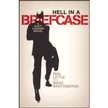
Hell in a Briefcase FIRST Tour


HAPPY NEW YEAR!!!
It is January 1st, time for the
FIRST Day Blog Tour! (Join our alliance! Click the button!) The FIRST day
of every month we will feature an author and their latest book's FIRST
chapter!


Leave a comment and you can win a free copy of the book!


This month's feature author is:
Phil Little with
Brad Whittington
and their book:
(A Matt Cooper Novel)


ELEVEN BRIEFCASES AND ONE UNLIKELY HERO...CAN MATT
COOPER FIND ELEVEN NUCLEAR DEVICES AND HIS FAITH BEFORE DISASTER
STRIKES?

With violence in the Middle East escalating daily, Americans are glued
to their televisions wondering what will happen next. Meanwhile, Matt
Cooper, jet-setting star of Phil Little's debut novel Hell in a
Briefcase
is doing something about it. A private security executive, his
adrenaline-junkie days consist of last-minute first-class overseas
flights, Hollywood parties with his actress girlfriend, and direct calls from
top CIA brass.
A chance meeting with Mr. Roberts, “an old broken-down millionaire” and
uncommon Christian, sends Cooper on a trip to Israel that will change
his life. Matt goes behind the curtain of Middle East terrorism,
witnessing firsthand the untold ravages of holy war. The deeper he goes, the
closer he gets to a plot involving eleven stolen briefcase nukes and a
plan infinitely more sinister than 9/11.

ABOUT THE AUTHOR:

Phil Little, president of West Coast Detectives and a recognized expert
in counter-terrorism, provides bodyguards to the stars and runs a
detective agency that has served ABC, NBC, CBS, CNN, FOX, Paramount, MGM,
and hundreds of others (www.westcoastdetectives.us). He draws on this experience in crafting the
tightly wound plot of this international thriller. In addition to his
duties as a security expert, Phil has also written Hostile
Intent
, Protecting Yourself from Terrorism and will soon be the
subject of a television pilot. In the meantime, you can read more about
Matt's adventures in his blog, http://detectivemattcooper.blogspot.com.

In addition, Phil is available for comment on all aspects of
international terrorism, both at home and abroad, and he makes for an interesting
and colorful guest. His expertise in the area of international issues
combined with his personable on-camera style would make for a great
interview on this hot topic. From Lebanese terror camps in the 1970’s to
American airports in the months before 9/11, Phil Little has witnessed
the terror threat up close and can share eye-opening stories and
information that all Americans should know.

THE FIRST CHAPTER:


Marjeyoun, Lebanon.

Thursday, 21 November 2002. 01:30.


A full moon. A glow seemed to rise from the sand, allowing them to
drive with their headlights off. The five Jeeps kept to 40 kph on the dark
road that wound southward between hills and wadis. In the third Jeep,
Major Skaff allowed himself the brief luxury of picking out Pegasus in
the sharp winter sky before he compulsively scanned the rocky terrain
for signs of Hezbollah fedayeen. He was leading this patrol to check out
rumors of increased activity near Shaaba Farms, the disputed area where
three Israeli soldiers had been kidnapped two years before.

The ridge road ran from the town of Marjeyoun down to Qlaia’a
under the ominous gaze of Shqif Arnoun-the castle called “Beaufort” by
the Crusaders-to the west. Christians and Muslims had fought for this
ground for centuries, trading possession of the castle as their fortunes
rose and fell. In the 1970’s the Palestinian Liberation Organization had
used the strategic placement of the castle to shell civilian
settlements in northern Israel.

That was when Skaff, then a young recruit of the Southern
Lebanese Army, had been a driver in a similar convoy, shortly before the
civil war broke out between Christians and Muslims in 1975. Traversing this
very ridge on a mission, he had come under fire from the castle. His
evasive driving had saved the convoy and drawn the attention of General
Lahd.

The intervening thirty years had been a generation of
unremitting war. Israel, tiring of mounting civilian casualties and the Lebanese
government’s refusal to expel the terrorists, invaded southern Lebanon
in 1982 and captured the castle. Eighteen years of occupation followed,
during which Skaff had risen through the SLA ranks while working openly
with the Israelis to keep the various Muslim factions at bay. When he
had started, Hezbollah did not exist. Now the radical Muslim army
controlled the south and dealt severely with the Christian resistance.

As the occupation had grown increasingly costly and casualties
mounted, the pressure increased for Israel to withdraw. When the SLA
collapsed in 2000, Israel destroyed what was left of the castle walls and
pulled back behind the Blue Line specified by the UN. The SLA
scattered. Thousands fled to Israel or went into hiding. Those who didn’t were
imprisoned and tried as enemy collaborators. As Hezbollah gained control
of the area, the anticipated slaughter of Christians didn’t
materialize. But any SLA militiamen emboldened to return were also imprisoned.

As he scanned the distant ruins of the castle in the moonlight,
Major Skaff reflected on change and constancy. Where PLO guns had once
rained death on Israel and Lebanese Christians, now tourists snapped
pictures and rushed home to post them on the Internet. And the same
General Antoine Lahd who had brought him up in the ranks and fought beside
him for decades had fled to Paris. Only a week ago he had opened a fancy
restaurant in Tel Aviv called Byblos. It had a nice ocean view.

True, Lahd had a death sentence hanging over him for treason and
war crimes, but so did Skaff. And so did many of the two thousand SLA
in Lebanese prisons.

But some things had not changed. Southern Lebanon was just as
dangerous for the men in these Jeeps as it had been when Skaff was
driving instead of commanding.

Skaff was drawn from his reflections by a dark shape ahead. At
the end of the ridge the road snaked through an outcropping of rock. He
had passed through it many times, always with reluctance. This night he
felt a peculiar sense of revulsion as he squinted at the misshapen lump
of stone looming before him.

He nudged his driver and nodded toward the rocks. Hassan nodded
back. He could feel it too. Skaff reached for the radio to signal the
lead Jeep. A lifetime of guerrilla fighting had convinced him that such
premonitions were not without merit. His transmission was brief, but
they were already entering the outcropping when he put the radio down.

Five seconds later a rocket hit the grille of the lead Jeep. The
explosion lit the rocks towering over them. He saw the silhouettes of
two men blow out on either side of the vehicle, which was tossed onto
the nose of the next Jeep. Hassan narrowly missed them, skidding left and
stopping next to the driver of the lead Jeep, who was lying half off
the road.

The two Jeeps behind slid sideways to a stop in the road as
machine gun bursts echoed from beyond the lead Jeep. Skaff was exposed to
the attack. He dove from his seat to the rear of the second Jeep,
between two men already returning fire with an Uzi and an M-16.

He rolled to his feet and yelled to the two back Jeeps,
motioning for them to form a double barricade with their vehicles, keeping the
men covered both in the front and the rear in case the attackers
attempted to sandwich them in the gap. Skaff turned back, confident that his
men needed no further direction. This mission called for
battle-hardened veterans, and he had personally selected the nineteen men who were
with him now. Every man among them had proved himself in years of combat.
Some even owed their life to his cool command in battle. Some had
returned the favor multiple times.

Skaff scanned the forward battle to account for the remaining
eleven men, his position shielded by the lead Jeep transfixed on the
grille of the second. To the left, Hassan was pulling the driver of the
first Jeep to safety. The other two men from Skaff’s Jeep were covering
him with sporadic fire from their Uzis. Ahead, the driver of the second
Jeep was placing a case of grenades handy to his partner, who had fitted
his M-16 with a grenade launcher and was set up in the backseat. Skaff
was standing beside the other two passengers in the second Jeep. That
left the three passengers from the lead Jeep.

He spotted Saif on the right. He had been thrown clear onto the
sand without apparent injury. He was crouched behind a boulder,
occasionally returning fire with his Desert Eagle .50-caliber side arm.
Failing to sight the other two, he shouted to the driver, who had acquired an
Uzi.

“Rafik? Sayyed?”

He nodded forward. Skaff crawled over the middle of the jeep to
the hood. Sayyed was wedged between the lead Jeep and the grille of the
second Jeep, most likely dead. Rafik was lying on the hood of the
second Jeep. Skaff checked for a pulse. Nothing. He closed Rafik’s eyes and
whispered a short prayer. Skaff couldn’t play favorites with his men,
but this loss was harder than any other would have been. At nineteen,
Rafik had already spent four years with Skaff, rarely more than fifty
yards from his side. Four years of relentless, driven hate. Skaff had been
Rafik’s ticket for revenge. Perhaps now he had found the peace revenge
had not been able to bring him.

Skaff was crawling back to get a weapon when the second rocket
hit the bottom of the lead Jeep. The gas tank exploded, sending most of
the shrapnel back toward the attackers. The force of the blast threw
the second Jeep back five feet, knocking over the two shooters behind.
The grenade launcher and the man with it fell into the front seat. The
driver was standing to the side. He returned fire with the Uzi.

Skaff helped reposition the grenade launcher and crawled out of
the Jeep. The two in back were already firing again. He scanned the
area and then dove toward the two Jeeps in the rear. Of the eight men
between the jeeps, one had taken a round in the right shoulder but was
still firing left-handed, propped against a door. Three were facing the
rear but indicated they hadn’t seen any action, yet. Two were covering the
walls on either side with M-16s, but also hadn’t seen action. The final
two had grenade launchers on their M-16s. They waited until they saw
several volleys of tracer bullets originating from a single location.
Then they fired three seconds apart at the source. The machine gun fire
stopped. Skaff slapped them on the back. Perhaps they would get out of
this thing alive.

Then a rocket hit Skaff’s Jeep. Hassan was behind a curtain of
stone, firing with an Uzi, having propped the injured driver in a cleft
in the rock. But the other two were using the Jeep for cover. One
tumbled backward, clear of the Jeep. The other was knocked down as the Jeep
rolled over, pinning his leg under it. Skaff ran through a volley of
automatic weapons fire and pulled the first man to his feet. They raced
to the Jeep, joined by Hassan, and rocked it back over. Then they
dragged the injured man to safety next to the injured driver.

Skaff felt a shudder of unease ripple through the
adrenaline-laced focus that always came over him in combat. If this kept up, the
whole team would be shredded before they had used half their ammo. He
grabbed Hassan’s arm and yelled into his ear over the din.

“We have to take out that rocket launcher or we don’t get out of
here. Take those three and circle around.” Hassan nodded and stepped
away but Skaff grabbed his arm. “Take a radio.”

He let go, and Hassan ran to the rear while the others laid down
covering fire. Skaff used the opportunity to race to the front two
Jeeps and get the four there away from the vehicles and behind the cover of
the rocks. As they ran for cover, another rocket hit the top of the
lead Jeep, sending fragments of the grille and fenders flying in all
directions. Skaff ran through the explosion back to the rock curtain. When
he fell against a boulder the injured man pointed at Skaff’s leg. He
looked down and saw that his left trouser leg was slashed in three places.
Blood was seeping down to his boots. He looked around to see how the
others had fared.

Saif seemed to have been hit in the arm by something. He was now
firing the Eagle while holding his upper arm with the other hand. The
other four seemed to have escaped unscathed. Skaff’s radio had not
survived the rocket. He nodded to the man next to him, who wielded an Uzi
while he made it to the two back Jeeps, getting an Uzi and a radio. He
turned it up all the way and slung it over his shoulder. Then he began
firing at the source of tracers beyond the rubble of the Jeeps.

Looking for some encouragement, Skaff probed his memory. In
almost three decades of fighting, he didn’t recall anything quite as dire
as the current circumstance. He had two confirmed dead, one unconscious,
three wounded but still firing. Almost a third of the force. The
numbers were bound to increase as long as that rocket launcher was working.
His calculations were interrupted by Hassan’s voice squawking through
the pandemonium.

“We got the rocket launcher, but I think they have another on
the left. And now we’re pinned down, so we’re going nowhere.”

The last word was drowned out by a rocket blast on the rock
curtain above the injured men. Skaff doubted he could get a team around the
other side. Even if he did, the enemy would be expecting them. No way
around. No way through. He scanned the sheer rock walls on either side.
No way over. The fedayeen had chosen their positions well and appeared
to have ample men, weapons, and ammo. It seemed likely that most of
this team would share the fate of Rafik and Sayyed. Probably all. The
thought sickened Skaff, turning the adrenaline in his veins to bile in his
throat.

There was one last hope, but it might be too late. He selected
another frequency on the radio and shouted over the gunfire, “Lehafil
Levanon Sanctzia. Lehafil Levanon Sanctzia.
(Activate Lebanon
Sanction.)”

Friday, December 08, 2006

Never Ceese by Sue Dent Blog Tour

This week the Christian Fiction Blog Alliance is doing a tour for Never Ceese by Sue Dent . It is notable that Sue is one of our CFBA members!


ABOUT THE AUTHOR

Sue Dent was born and raised in Jackson, Mississippi and currently resides in Ridgeland. When not writing, Sue designs websites and works with digital photograpy.

Sue loves to hear from her fans through her Website in fact, the push from eager readers has already set the ball rolling, and she's hard at work on Forever Richard, the sequel.

In Never Ceese, Sue sets out to prove that faith and fun can live happily in the same story, and that vampire/werewolf fantasy can have a spiritual message too.


ABOUT THE BOOK:


Never Ceese takes religious fantasy to a new level, bringing an entirely new Light to a very dark side of fiction, doing a very admirable job to prove that vampire/werewolf fantasy does not have to be evil to be enjoyed.

The story starts with the classic tale of an English manor owned by Richard, the vampire who righteously is the bain of his neighbor's existence, what with the missing goats and all!

Then enters Cecelia, better known as Ceese, the young werewolf maiden who's arrived via invitation by Richard's aging companion, Penelope.

Ceese and Richard would prefer to tear each other apart, literally, but they are drawn together by their mutual love for Penelope. She is dying and has one request...that the two of them love one another.

This is the overall theme throughout Dent's interesting tale of two who were wronged but learn to work together. Meanwhile they are threatened by an evil stem cell researcher who wants the immortality and power that he thinks their blood will bring him!

Dent's characters do differ from the stock one's we're all accustomed to in a very important way. They are not mindless, brutal killers. Bloodthirsty, yes, but they are constantly resisting the urge to kill, and, thus, curse another human. Feeding on rodents, goats, virtually any warm-blooded animal helps to satiate the never ending thirst for blood, but how long will they be able to resist that most delicious morsel man?

There is a chance that their curses can actually be lifted if they can find the strength within to resist their selfish natures and act selflessly toward another. Will they succeed? That same basic choice lies before us all every day...

A vampire and a werewolf, one determined to, once again, be able to acknowledge what will get her to heaven, the other no so sure he can. A spiritual fantasy designed to spark the imagination, to speak to the heart as well as entertain.